
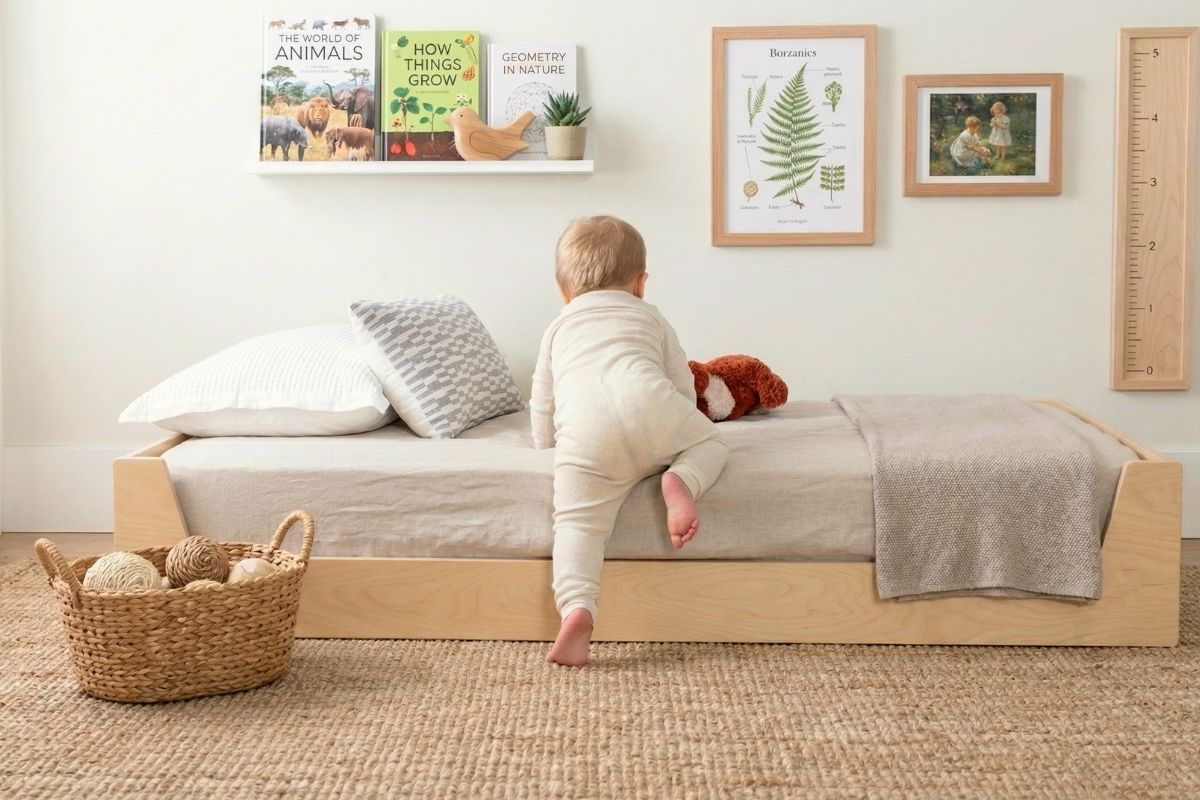
The first question parents ask when they discover Montessori is almost always the same, you want me to put my baby on the floor to sleep? Without a crib? It sounds wrong at first. Then you start understanding why, and it starts to sound like the most logical thing in the world.
The Montessori sleeping area is not a furniture choice. It is a philosophical position on what sleep means for a growing child, what freedom of movement requires, and why containing a baby in a barred box for the first year of their life might not be the setup we think it is.
The Montessori Sleeping Area at a Glance
- Newborn (0-3 months): Moses basket or cestina in the sleeping area, firm and flat
- From ~2 months: Floor bed transition begins, alongside the Moses basket
- Floor bed: Firm crib or twin mattress directly on the floor, or on a very low frame
- The room IS the crib: The entire baby-proofed bedroom becomes the safe space
- Sleeping area rules: No mobiles, no toys, no visual stimulation. Sleep only.
- AAP note: Only labeled cribs, bassinets, or play yards are officially recommended for sleep under 12 months
Why No Crib?
The crib is one of the most accepted pieces of baby furniture in the western world. It is also, from a Montessori perspective, a container that tells a baby: you are here until someone decides to move you.
A baby in a crib cannot choose when to move. Cannot decide to shift position, crawl to the edge, or explore the space around them when they wake. When they are finished sleeping, or simply not sleeping, their only available option is to call for an adult. The crib makes them completely dependent for something as fundamental as changing their physical position in space.
The floor bed does not put a baby at risk. It changes the relationship between the baby and their sleeping space. With a properly baby-proofed room, a firm mattress on the floor, and safe sleep practices in place, the baby can begin to develop an awareness of their own body and boundaries from the earliest weeks. They can see their environment without bars in the way. When they become mobile, they can choose to move. The room becomes a safe container instead of the crib.
What Research Says: A 2022 study published in Sleep Medicine found that sleep environment consistency and reduced parental intervention at bedtime were associated with longer consolidated nighttime sleep at six months. The quality of the sleep environment, including darkness and appropriate setup, was more predictive of outcomes than any specific piece of furniture.
The Newborn Stage: Moses Basket First
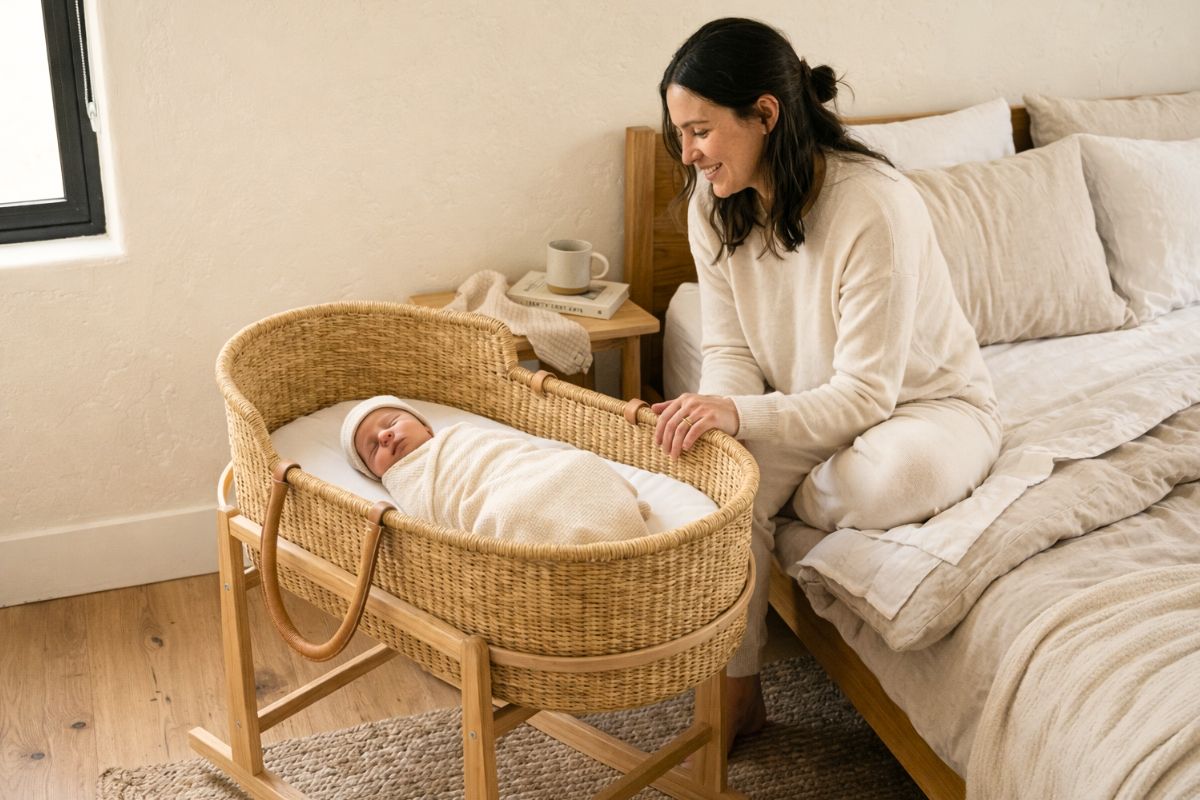
Montessori does not put a newborn directly on a floor mattress. The newborn stage begins with a small, portable basket, called the cestina or Moses basket in the Montessori tradition.
Why The Moses Basket?
Newborns need two things that can seem contradictory. Closeness to their caregivers and a consistent, familiar sleep space. The Moses basket solves both. It is small, warm, and can be moved from room to room so the baby is near the family during the day and near the parents at night. Its small size provides the contained, womb-like security that newborns need in the early weeks.
Critically, unlike a crib, the Moses basket has no bars. The baby can see their environment. They are not visually cut off from the world when awake in the basket. And the basket sits low enough that placing and retrieving the baby feels natural rather than strained.
Works well
No bars obscuring view
Familiar scent, familiar surface
Supports room-sharing guidelines
Transitions away from it
When baby can roll (~2 months)
The Floor Bed: Setup, Safety, and Timing
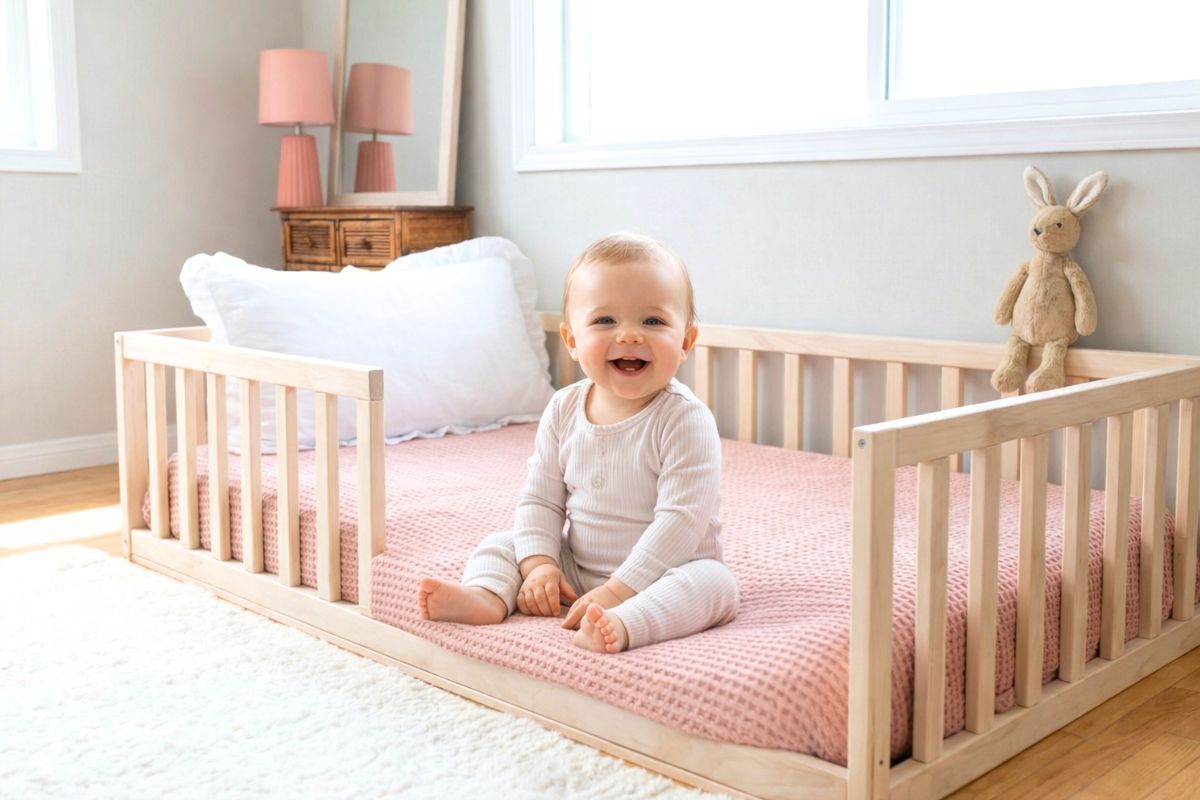
The floor bed transition usually begins around 2 months, or whenever the baby starts showing more mobility and the Moses basket starts to feel small. Many families run both simultaneously for a period, using the Moses basket for naps near the family and the floor bed for overnight sleep.
Setting Up The Floor Bed
The mattress: A firm crib mattress or twin mattress placed directly on the floor. Not a soft adult mattress. For babies under 12 months, firmness is non-negotiable for safe sleep. A twin-sized mattress is worth considering from the start as it will serve the child for years.
Position in the room: Away from the wall by at least 12 inches on the open side, so there is no gap between mattress and wall where a baby could become wedged. Against a wall on one side only, if at all.
Bedding: A fitted sheet only, for babies under 12 months. No loose blankets, pillows, bumpers, or soft objects in the sleep space. A sleep sack replaces blankets entirely.
The room: Fully baby-proofed before the floor bed is introduced. Furniture anchored to walls. Outlets covered. No cords in reach. No objects the baby can pull down. The entire room becomes the safe space, not just the mattress.
Optional low frame: Some families use a very low wooden bed frame (3 to 5 cm off the floor) for air circulation, particularly in humid climates. This is fine. What matters is that the sleeping surface remains low enough for the baby to roll off safely, which is only possible when the mattress is essentially at floor level.
Safe Sleep Note: The American Academy of Pediatrics (AAP) recommends only labeled cribs, bassinets, portable cribs, or play yards for sleep under 12 months. A floor mattress is not among the AAP-approved surfaces for infant sleep. Many Montessori families choose to use them with careful implementation. If you use a floor bed before 12 months, apply all other safe sleep rules without exception: firm mattress, no soft bedding, back sleeping, smoke-free environment.
How the Sleeping Area Evolves (0-12 Months)
The Design of the Sleeping Area
The sleeping area is intentionally different from the movement area in one key way: it should offer no invitation to play. When the baby is in the sleeping area, the message from the environment should be consistent: this space is for rest.
What The Sleeping Area Includes
- Firm, flat mattress at floor level
- Fitted sheet in natural, calm fabric
- Sleep sack appropriate for the room temperature
- Blackout curtains or blind (darkness supports melatonin production)
- White noise machine if desired (consistent, not musical)
- Soft, warm lighting for night feeds and nappy changes
What The Sleeping Area Does Not Include
- Mobiles of any kind (these belong in the movement area)
- Toys, books, or stimulating objects
- Bright colors or visually busy walls near the mattress
- Soft pillows, loose blankets, stuffed animals (safe sleep)
- Mirrors (save these for the movement area)
The separation between sleeping and playing is a Montessori principle that serves the child throughout childhood. When sleeping and playing happen in the same defined space with the same stimulation, the transition to sleep becomes harder to predict. When the sleeping area is consistently calm and free of invitation, the child learns to associate it with rest.
Questions Parents Ask Most Often
What if my baby rolls off the mattress?+
They drop a few centimetres onto the floor. With a rug or soft mat around the mattress, this is a non-event. Babies roll off the mattress regularly, especially once they start rolling in their sleep. Because the mattress is at floor level, the fall is the same distance as rolling off a rolled-up blanket. Most babies don’t even wake up. This is exactly why the floor bed works: small falls are safe and self-correcting.
Won’t my baby just crawl around the room at night once they are mobile?+
Sometimes, yes. And this is where the fully baby-proofed room matters completely. If the room is safe, the exploration is not a problem. What Montessori families consistently report is that babies who explore the room at night eventually return to the mattress to sleep. They learn, over time, that the mattress is the sleeping place. The room is safe for them to navigate. Consistency in the bedtime routine, not containment in a crib, is what teaches sleep.
Do I need to buy a special floor bed frame?+
No. A mattress on the floor is the purest version of the floor bed and also the cheapest. Many families start there and add a low wooden frame later if they want air circulation underneath. The house-shaped floor beds widely marketed as Montessori beds are decorative: they are nice, but they are not the point. The point is the low, accessible sleep surface. A crib mattress on a rug costs nothing extra if you already have it.
Is it cold on the floor?+
The floor is typically a few degrees cooler than raised surfaces. Solutions: a rug or mat under the mattress, a slightly warmer sleep sack than you might otherwise use, or a very low frame that lifts the mattress 3 to 5 cm and allows some airflow. In very cold climates, some families keep the floor bed during warmer months and use a low platform bed in winter. The temperature difference is manageable with the right sleep sack rating.
The Sleeping Area Is the Simplest Zone
There is a paradox at the center of the Montessori sleeping area: it requires more preparation (a fully baby-proofed room) but less furniture (no crib). The investment is in the environment, not the equipment. And the outcome is a child who from the earliest months lives in a space that is theirs, not a space they are placed in and removed from.
Start with the Moses basket. Set up the floor mattress. Baby-proof the room before it matters. Then let the space do what it was designed to do.
Scientific References
Kaplan, E.R. et al. (2022). Associations of sleep-related behaviors and the sleep environment at infant age one month with sleep patterns in infants five months later. Sleep Medicine, 94, 31–37.
Moon, R.Y. et al. (2022). Sleep-Related Infant Deaths: Updated 2022 Recommendations for Reducing Infant Deaths in the Sleep Environment. Pediatrics, 150(1), e2022057990.
Davies, S. & Uzodike, J. (2021). Montessori Baby. Workman Publishing.