
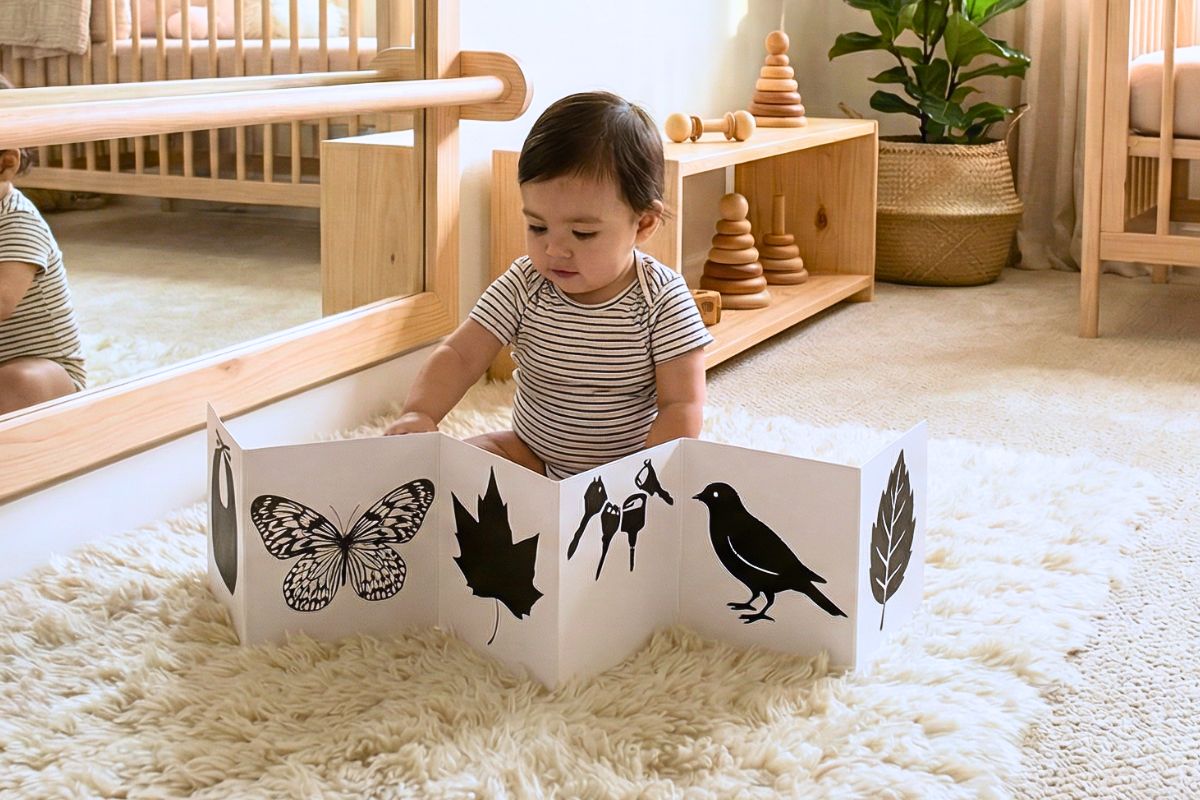
I had a stack of black and white flashcards waiting before my daughter was even born. I had read that newborns only see in black and white, so I bought the cards, printed some patterns, and felt very prepared. Then I actually learned how vision develops in the first weeks of life, and the cards went back in the drawer. Not because they are useless, but because I had no idea how to use them, or why they work, or what to do next.
This article is what I wish I had read first. The science is more interesting than the flashcard boxes suggest, the Montessori answer to this problem predates flashcards by decades, and the practical guidance most parents never get is straightforward once you understand what is actually happening in your newborn’s eyes.
Quick Reference
- Do babies only see in black and white? No, but close. Color vision exists from birth in a very limited form. High contrast matters most from 0 to 14 weeks.
- When do babies see color? Red is detectable from a few weeks. Greens and blues develop through 2-4 months. Full color by 5-6 months.
- Best distance to show images: 20-30 cm (8-12 inches) from the baby’s face (the distance from arm to elbow)
- Session length: 2-4 minutes, a few times a day. Stop when the baby looks away: that is their signal, not a failure.
- Complexity rule: Start with simple, single-element patterns. Add complexity only as the baby can track and sustain attention.
- The Montessori original: The Munari mobile is a black, white, and transparent visual stimulus designed specifically for this developmental stage.
- When to stop: Around 12-14 weeks, high-contrast images become less urgent as colour vision and visual acuity develop rapidly.
The Myth and the Reality: What Newborns Actually See
“Babies see in black and white” is one of those statements that is close enough to true to stick, but imprecise enough to mislead. The reality is more specific, and more interesting.
At birth, the retina’s cone photoreceptors, which are responsible for color vision, are present but structurally immature. The fovea, the high-resolution central zone of the retina, continues developing until around 15 months of age. This means that a newborn’s color vision is not absent: it is severely limited in both saturation and sharpness. Everything looks desaturated, blurry, and low-contrast.
What The Research Actually Shows: A 2022 review published in Child Development Perspectives (Skelton, Maule & Franklin) found that newborns can detect some color from birth, particularly high-saturation reds, but their color discrimination is poor, requiring strongly saturated, large stimuli to register at all. Within 6 months, however, infants go from this near-colorblind state to a sophisticated color perception system capable of categorizing hues. This rapid trajectory makes the first three months the window where high-contrast black-and-white stimulation has the most developmental leverage.
The reason black and white images work is not that black and white is all a baby sees. It is that black and white represents the maximum possible contrast between light and dark, making it the easiest visual signal for an immature retina to detect and process. High contrast images create strong signals that travel efficiently along the still-developing optic nerve to the visual cortex, which responds by building and strengthening the neural connections that will eventually support all visual processing.
A foundational study by Robert Fantz (1963), published in Science, demonstrated for the first time that newborns have visual preferences: they attend longer to patterned stimuli than to plain fields, and longer to high-contrast edges than to low-contrast ones. This work established the evidence base that has since driven six decades of research on infant visual development.
Free Printable
25 High Contrast Images for Newborns
25 black and white printable cards for infant visual stimulation from birth to 3 months. Simple patterns, geometric shapes and animal faces – print, cut, and use from day one.
Month-by-Month: Vision Development and What It Means for Stimulation
What your baby can see changes rapidly. The type of images worth showing should change with it.
On Red: Red is the first non-black-and-white colour a newborn can detect, appearing within the first few weeks. This is why some high-contrast card sets include bold red accents alongside black and white: it is not arbitrary. From around 4-6 weeks, occasional red elements alongside high-contrast patterns are genuinely appropriate.
The Montessori Answer Came First: The Munari Mobile
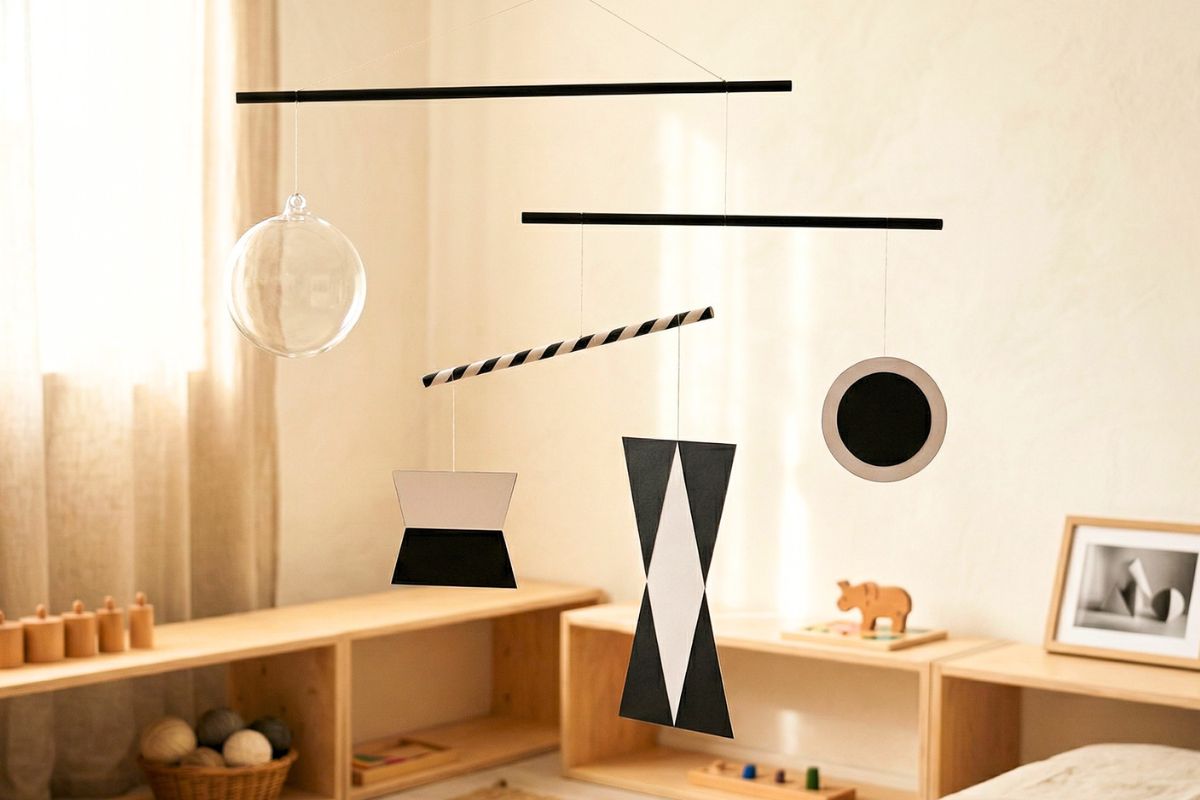
Before flashcard companies existed, Maria Montessori and her colleagues developed visual materials for newborns based on the same developmental principles the science has since confirmed. The Munari mobile is the most important of these.
Designed by the artist Bruno Munari and adopted into Montessori practice for newborn environments, the Munari mobile consists of geometric shapes in black, white, and transparent glass spheres, suspended at approximately 25-30 cm above the baby’s face. It moves slowly in air currents. The shapes are simple but varied: a sphere, a cube, a cone, and the combination of high contrast, three-dimensional form, and gentle movement provides exactly the visual input a developing visual cortex needs without overstimulating it.
Why The Munari Mobile Is Different From Flashcards: A mobile hangs at a fixed distance (already calibrated), moves naturally and unpredictably (training visual tracking without forcing it), and is three-dimensional (developing depth perception alongside pattern recognition). Flashcards require a parent to hold them at the right distance, move them appropriately, and time the session well. Both work. The mobile requires less active management and fits more naturally into the movement area setup.
The Munari mobile is followed in the Montessori sequence by the Octahedron mobile (three-dimensional geometric shapes in primary colors), which introduces color at exactly the developmental stage when the visual system is ready for it. The sequence mirrors what the science shows about the order in which visual processing matures.
How to Actually Use Black and White Images
The images matter less than how you use them. Most parents who get no results from flashcards are simply holding them too far away, using them too long, or using images that are too complex for the baby’s current visual ability.
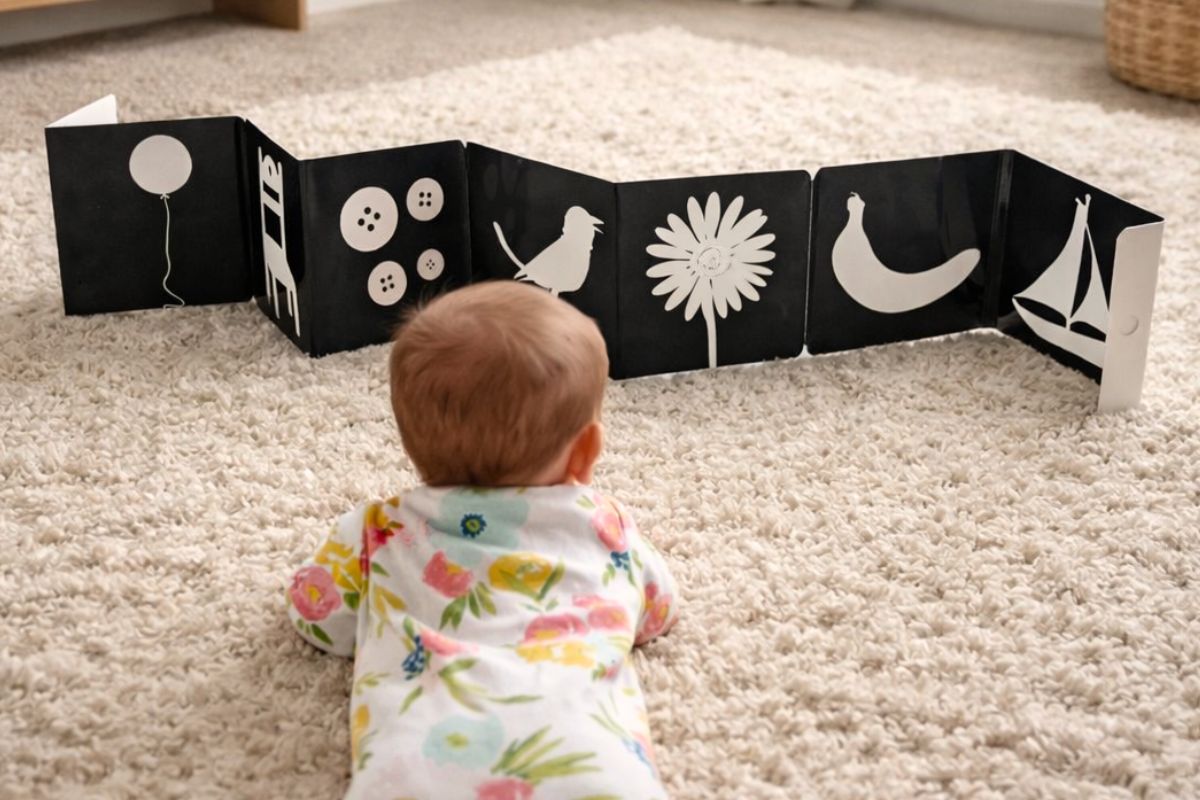
Distance: 20-30 Cm, And Not More
A newborn’s focus range is approximately 20-30 cm. Beyond that, everything is a blur. Hold the card or image at the distance from your wrist to your elbow: that is about right for the first weeks. As the baby grows (by 6-8 weeks, focus range extends to around 45 cm), you can move slightly further back. But many parents show cards at arm’s length to a one-month-old and wonder why the baby is not interested. They cannot see it clearly.
Duration: Follow The Baby’s Lead, Not A Timer
A baby who is looking at an image is engaged. A baby who looks away has finished with it. Two to four minutes of focused looking is a productive session. Twelve minutes of a baby turning their head away while a parent holds up a card is not. Show one image, hold it still, wait for the baby to disengage (they will look away, blink repeatedly, or become fussy), then either move to a new image or end the session. Short and positive beats long and effortful.
Complexity: Simple First, Always
Newborns process edges and borders before patterns, and simple patterns before complex ones. A concentric circle or a bold checkerboard is more appropriate at two weeks than a detailed animal illustration. Start with the simplest images in any set. The baby’s sustained attention is your guide to when they are ready for more complexity. If they glance at a card and look away within seconds, the image may be too complex or your timing is off. If they stare for 30-60 seconds, the image is working.
Timing: After A Nap, Before Hunger
A hungry, overtired, or overstimulated baby will not engage with visual images. The window for alert, receptive wakefulness in newborns is narrow, often 20-40 minutes between waking from a nap and feeding. That is your window. Use it. Diaper change time is also surprisingly productive: the baby is alert, flat on their back, and has nothing else to look at. Taping a card to the wall behind the changing area is one of the simplest setups that genuinely works.
Where to Place Black and White Images
Images do not have to be in your hands to be useful. Placing them in fixed locations means the baby encounters them passively during the activities that fill their day.
- Changing table wall: One card at the baby’s eye level, 25 cm away. Changed weekly to maintain novelty.
- Movement mat: A card propped against a book in front of the baby during tummy time, or beside them during back time.
- Nursing chair: On the wall opposite the chair at baby’s typical head position during feeds.
- Stroller: Clipped to the stroller canopy facing the baby during walks; several card sets include a stroller clip for exactly this.
- Crib side: Not inside the sleep space (keep the sleep environment minimal and unstimulating), but on the wall visible from the crib when the baby is awake.
The Best Black & White Image Products
There are four types of high-contrast visual products, each with a different use case. You do not need all four.
Type 1: Classic High Contrast Flashcards (0-3 Months)
Simple large-format cards with bold geometric patterns in black and white, double-sided, around 15-22 cm square. These are the workhorse of the format: large enough for a newborn to see clearly, simple enough for the earliest visual processing stage, and easy to prop against a surface or hold at the right distance. Look for matte surfaces (anti-glare) and rounded corners for safety. The matte finish matters: a glossy card creates reflections that confuse a newborn’s visual system.
Good for
Propping against surfaces
Diaper change wall
Budget-friendly
Type 2: Wee Gallery Art Cards
Best for Longer Use (0-12 Months)
Wee Gallery art cards are high-contrast animal illustrations in black and white, printed on FSC-certified card stock with soy-based inks, matte lamination, and rounded corners. The 5×7 inch format is slightly smaller than standard flashcards, making them appropriate as the baby’s visual acuity sharpens and they can process finer detail. The animal designs are simple enough for the early weeks but detailed enough to remain engaging at 3-4 months, when the baby starts recognising shapes as representational objects rather than just patterns. They last well beyond the high-contrast phase as picture naming cards for older babies.
Materials & Safety
FSC-certified recycled card stock, soy-based non-toxic ink, matte lamination, child-safe rounded corners. Water-resistant wipe-clean surface.
Natural materials, FSC certified
Montessori-friendly aesthetic
Type 3: Tummy Time Board with Mirror
Best All-in-One Setup (0-4 months)
An accordion-fold standalone board that holds 6 interchangeable double-sided cards plus a baby-safe shatterproof mirror at one end. The whole assembly stands independently on the floor in front of the baby during tummy time. This solves the most common problem with flashcards: you need both hands free, and holding a card at exactly the right distance for 3 minutes is harder than it sounds. The board sits at 25 cm from the baby’s face by design, the mirror provides the single most motivating visual stimulus (the baby’s own face), and you can swap cards to match the baby’s developmental stage. The ZICOTO version is designed in the US with thick standalone board and safe materials.
Mirror + cards combined
Best tummy time companion
Cards rotate by stage
Type 4: Wipeable Cards with Stroller Clip
Best for On-the-Go (0-4 Months)
Laminated wipe-clean cards in a small format, designed to clip to a pram or car seat hood so the baby has visual stimulation during walks and car rides. These are not designed for the same focused session work as larger cards: the format is compact and the context is passive. But they work well as a supplement, ensuring the baby has something worth looking at during the substantial time spent in the stroller in the first months. The GeniusBabies set includes black, white, and red cards with a clip; the red is appropriate from around 4-6 weeks onward.
Wipeable, easy to clean
Black + white + red
Non-toxic, lead and BPA-free tested
Quick Comparison
Questions Parents Ask Most Often
Can I just download and print black and white images?+
Yes. Printed A4 or A5 sheets work just as well as purchased cards, provided the images are high-contrast, the print quality is crisp, and you use matte paper or laminate to reduce glare. Free printable sets are widely available online. The developmental effect comes from the pattern and contrast, not the packaging.
When should I stop using black and white images?+
There is no hard stopping point, but the high-contrast phase matters most between birth and about 14 weeks. From around 3-4 months, color vision develops rapidly and colorful objects, picture books, and a visually rich environment become more appropriate. If your 4-month-old seems more interested in colorful toys than in black and white patterns, follow that interest: their visual system is telling you it is ready for the next stage.
My baby does not seem interested in the cards. Is something wrong?+
Usually not. Check the distance first: most parents hold cards too far away for a newborn’s focus range. Check the timing: a hungry or drowsy baby will not engage. Check the complexity: a very detailed card may be beyond the baby’s current visual processing. And consider that your face is actually the most compelling visual stimulus a newborn can see. A baby who ignores a card but stares at your face for minutes at a time is doing exactly the right thing. Cards supplement, they do not replace, face-to-face interaction.
Is there a risk of overstimulation?+
Yes. Short sessions (2-4 minutes) with one or two images are the right approach. A baby shown ten different cards in rapid succession, or kept looking at a complex image when they are trying to look away, will become fussy. Looking away is the baby’s way of saying “I need a break.” Respect it. Two minutes of engaged looking is more valuable than twenty minutes of resistance.
The Short Version
Your newborn’s visual system is not broken: it is building itself. High-contrast images give it the right raw material to do that work. Hold them close, keep sessions short, start simple, and follow the baby’s attention rather than a schedule.
If you are setting up a dedicated space for your baby’s visual development alongside tummy time and free movement, the movement area guide covers the full setup from birth: mat, mirror, mobile sequence, and how it all evolves through the first year.
Scientific References
Skelton, A.E., Maule, J. & Franklin, A. (2022). Infant color perception: Insight into perceptual development. Child Development Perspectives, 16(2), 90–95.
Aguiar, C.P., Cortez, L., Valério, P. et al. (2023). Visual stimulation in the neonatal and pediatric intensive care. Advances in Ophthalmology & Visual System, 13(3), 96–99.
Maule, J., Skelton, A.E. & Franklin, A. (2023). The development of color perception and cognition. Annual Review of Psychology, 74, 87–111.
Fantz, R.L. (1963). Pattern vision in newborn infants. Science, 140(3564), 296–297. (Foundational study establishing visual preference in newborns)