
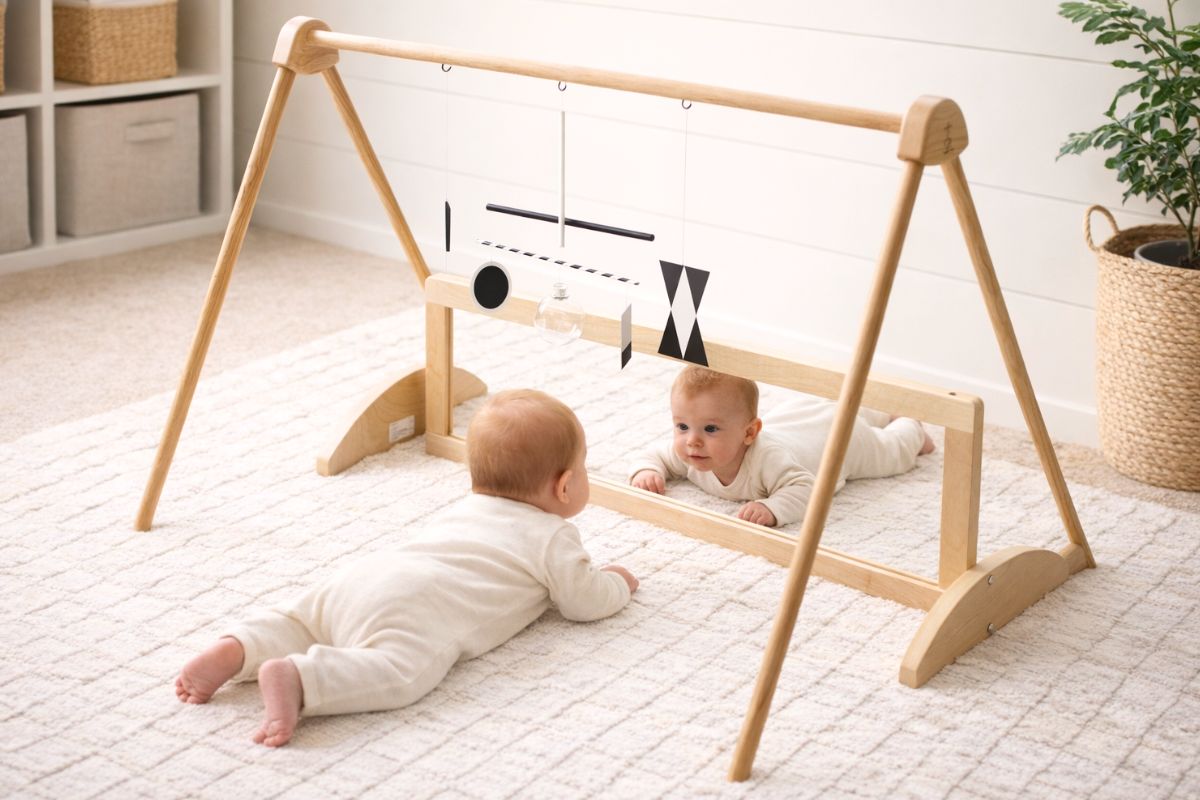
My son was two weeks old when I first put him on the floor. Not in a bouncer, not propped on a nursing pillow, just on a firm mat, on his back, in front of a low mirror. He lay there for about four minutes. His eyes found his own reflection. His legs kicked. His hands opened and closed. Nothing happened, by any normal measure. But something was clearly going on.
That four minutes on the floor, doing nothing in particular, was the beginning of the movement area. It’s the simplest setup in the Montessori nursery and the one that does the most work across the entire first year.
The Movement Area at a Glance
The movement area is a dedicated floor space where your baby spends all their awake time. It is where visual development, gross motor skills, fine motor skills, and independent exploration all happen, from the first reflexes of a newborn to the first steps of a one-year-old.
- What it is: A safe, floor-level space with a mat, mirror, mobiles, and a small selection of age-appropriate materials
- When it starts: From birth: the newborn is placed here during every awake period
- How it evolves: The space expands and materials change as the baby develops, month by month
- The core principle: Allow movement to develop without interference. Don’t rush. Don’t prop. Don’t contain.
Why Movement Is the Work of the First Year
In Montessori, movement is not exercise. It’s not a way to tire babies out before sleep. Movement is how the brain builds itself in the first year of life.
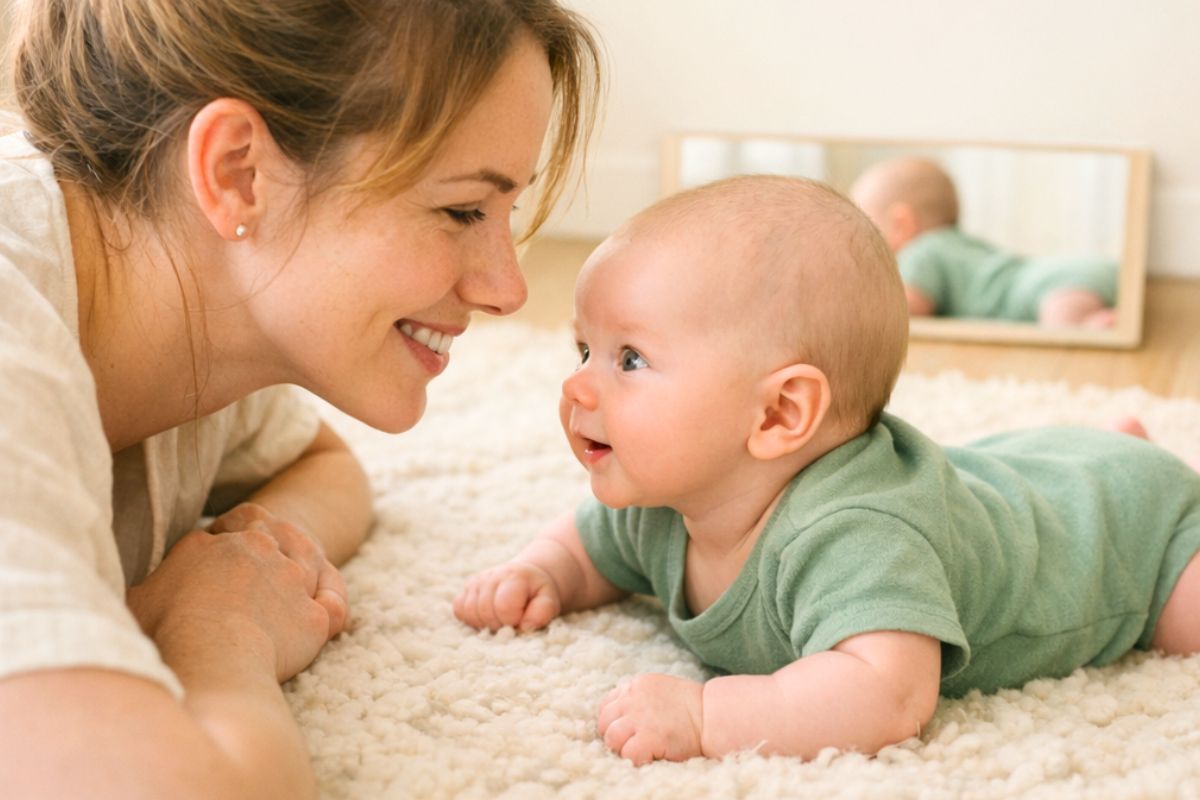
What the research shows: A 2022 longitudinal study following 411 infants found that greater tummy time was consistently associated with more advanced gross motor development and earlier achievement of all motor milestones, while higher restrained time (bouncer seats, car seats) was linked to delayed standing and walking. A systematic review published in Pediatrics (Hewitt et al., 2020) confirmed that supervised prone floor time during awake periods supports motor, visual, and sensory development and is now recommended by the AAP, WHO, and major pediatric bodies from birth onward.
Every time a baby kicks, rolls, reaches, grasps, or bears weight on their hands, they are laying down neural pathways that make the next movement possible. The sequence matters: swiping leads to grasping, tummy time leads to rolling, crawling leads to pulling up. None of these can be skipped or hurried, and none of them happen well in a bouncer, a swing, or a propped position the baby hasn’t reached on their own.
The movement area exists to give the baby unrestricted floor time: the condition under which all of this development naturally unfolds. It doesn’t need to be complicated. What it needs is to be consistent and safe.
The Core Montessori Principle On Movement
“Provide opportunity and freedom to move. Remove obstacles to movement, like swaddles or props. Do not put the baby in containers. Do not hurry or encourage any kind of movement before the baby comes to it on their own.”
How to Set Up the Movement Area
The setup is simple and intentionally minimal. Here is what you need, in order of priority.
1. The Floor Mat
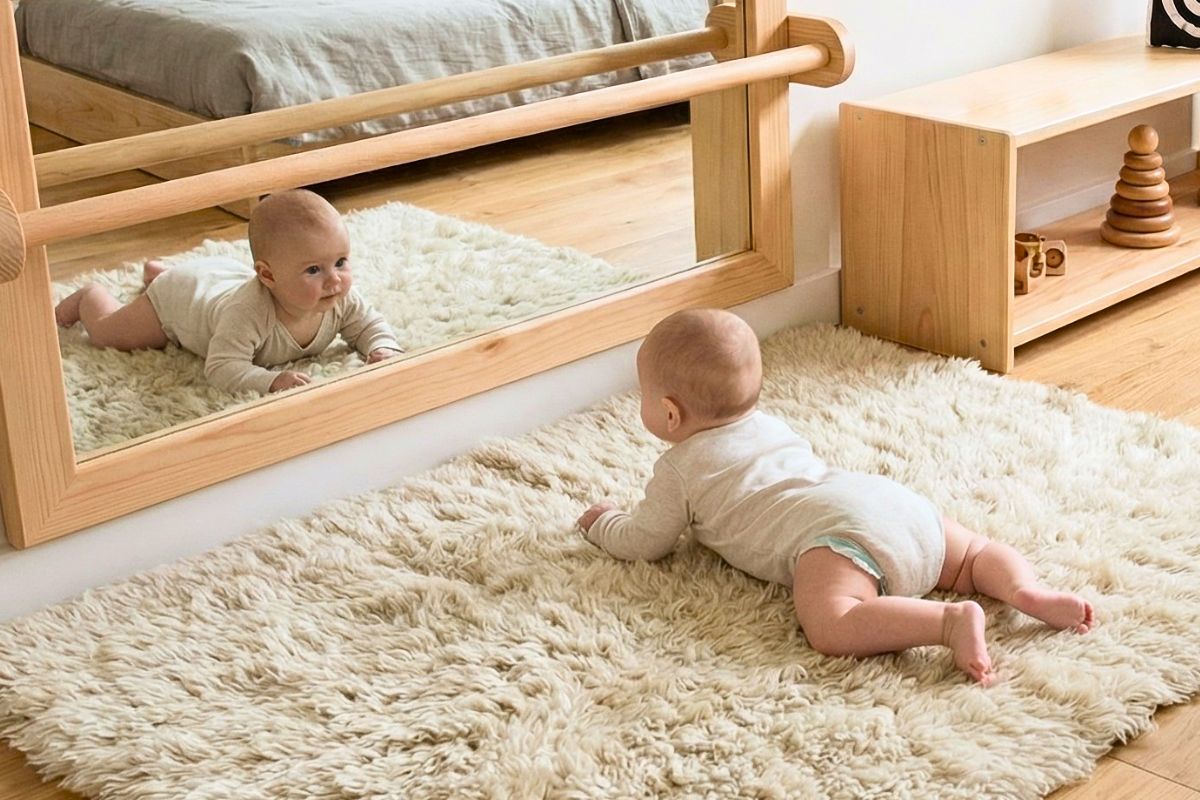
A firm, flat surface clearly marked as the baby’s space. A thick cotton rug or a firm foam mat works well. It should be large enough for the baby to roll without leaving it and comfortable enough for you to sit beside them. Avoid soft, plush surfaces that sink. Babies need firmness under them to push against and develop strength. A portable crib mattress works for early months and can be swapped for a rug once the baby starts sitting and rolling.
2. The Mirror
The mirror is positioned horizontally at floor level, beside the mat. When the baby lies on their back or does tummy time, they can see themselves and the room behind them. This serves several purposes at once: it supports body awareness, encourages tracking and focus, motivates tummy time (babies will lift their head to look), and later, pulls babies to crawl toward their own reflection.
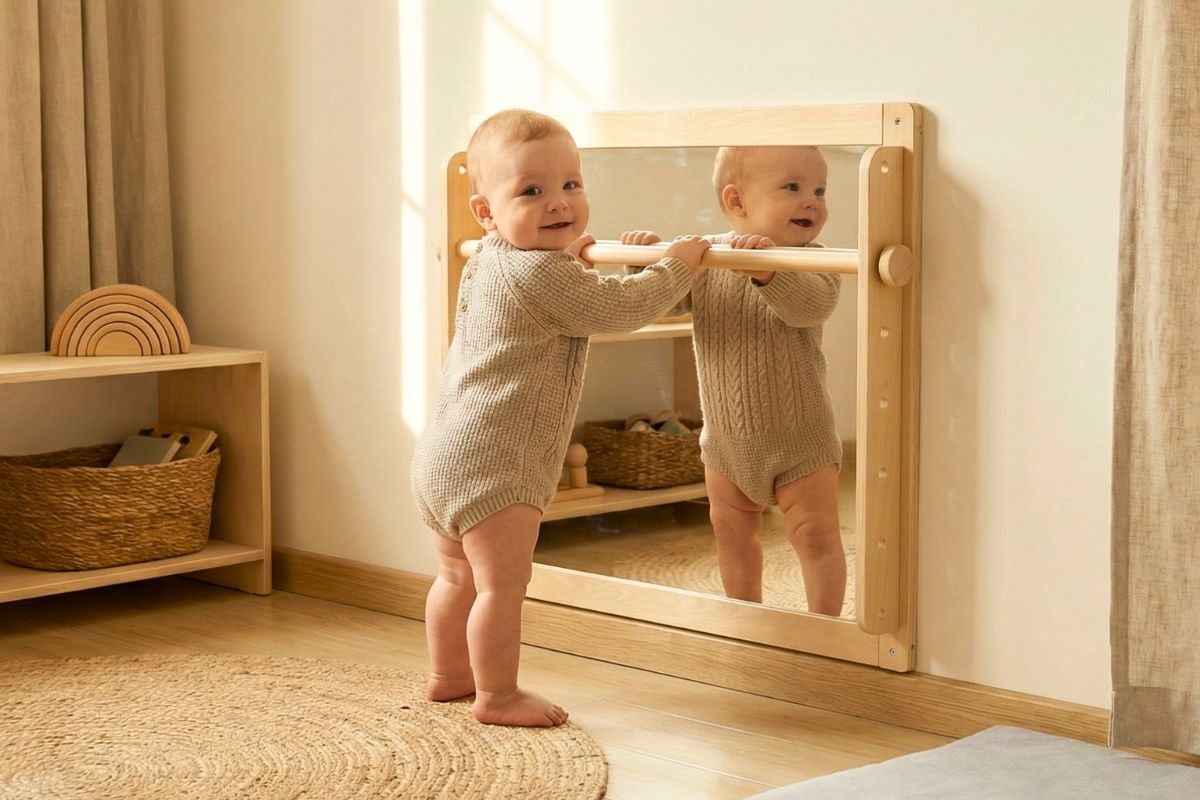
Use a shatterproof acrylic mirror, not glass, in the early months. The IKEA LOTS mirror ($20) works well mounted horizontally at low height. As the baby transitions to pulling up, repositioned the mirror vertically at standing height beside a pull-up bar.
3. The Mobile Hook
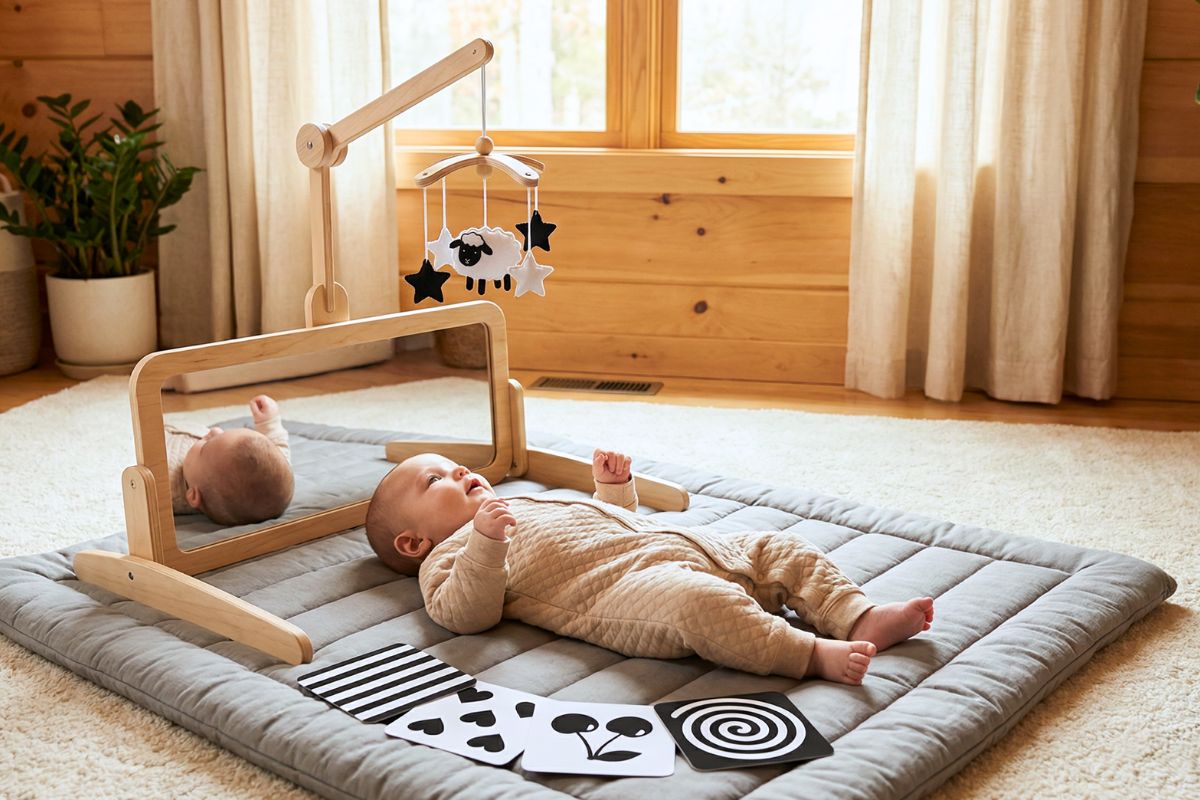
A ceiling hook directly above the mat, or a standing mobile arm, allows you to hang the Montessori visual mobiles during awake time. Position the mobile 25-30 cm above the baby’s eyes, close enough to see clearly, far enough to require focus. Important: mobiles belong in the movement area only, never above the sleeping space. The sleeping area must be calm and free of visual stimulation.
4. The Low Shelf
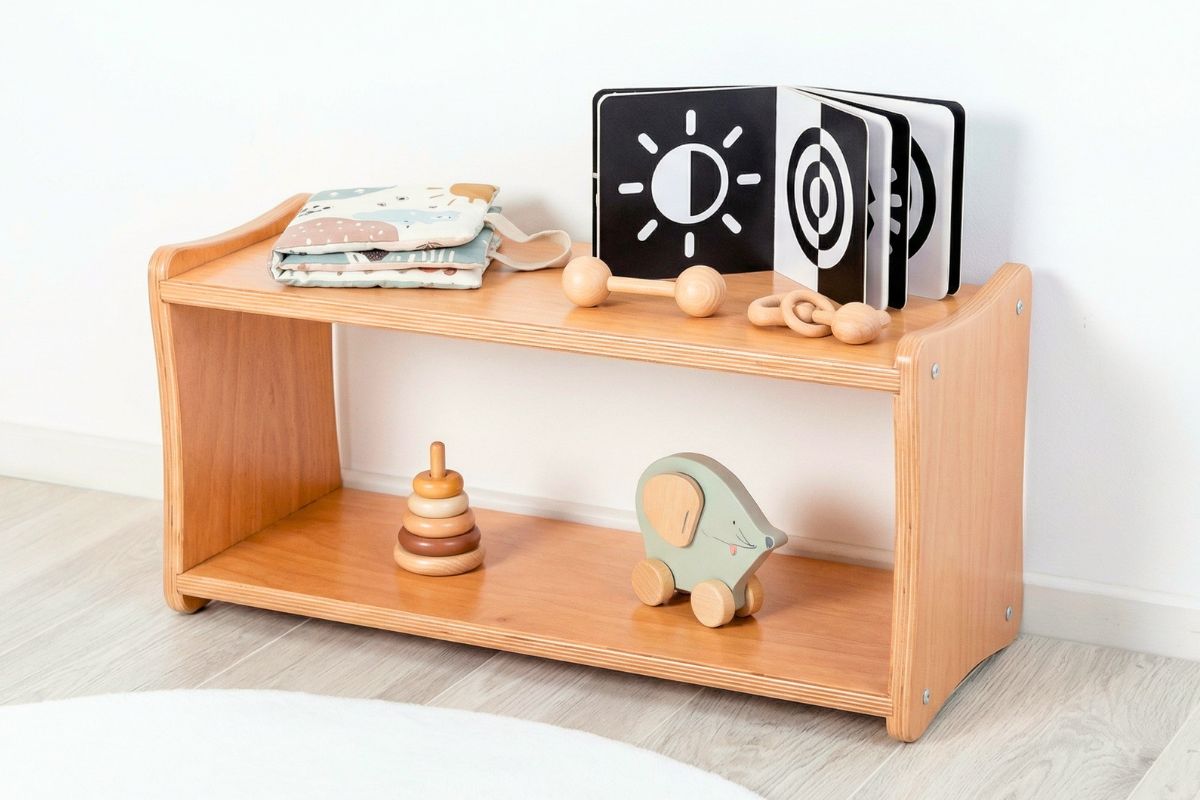
From around 3-4 months, when the baby begins reaching intentionally, add a small open shelf within the movement area. Keep only 3-5 items on it at a time. These are not toys in the traditional sense. They are materials for exploration. As the baby develops mobility, the shelf becomes a natural draw: first to look at, then to reach for, then to crawl toward. The shelf evolves with the baby and is one of the main ways the movement area transitions across the first year.
5. The Pull-Up Bar
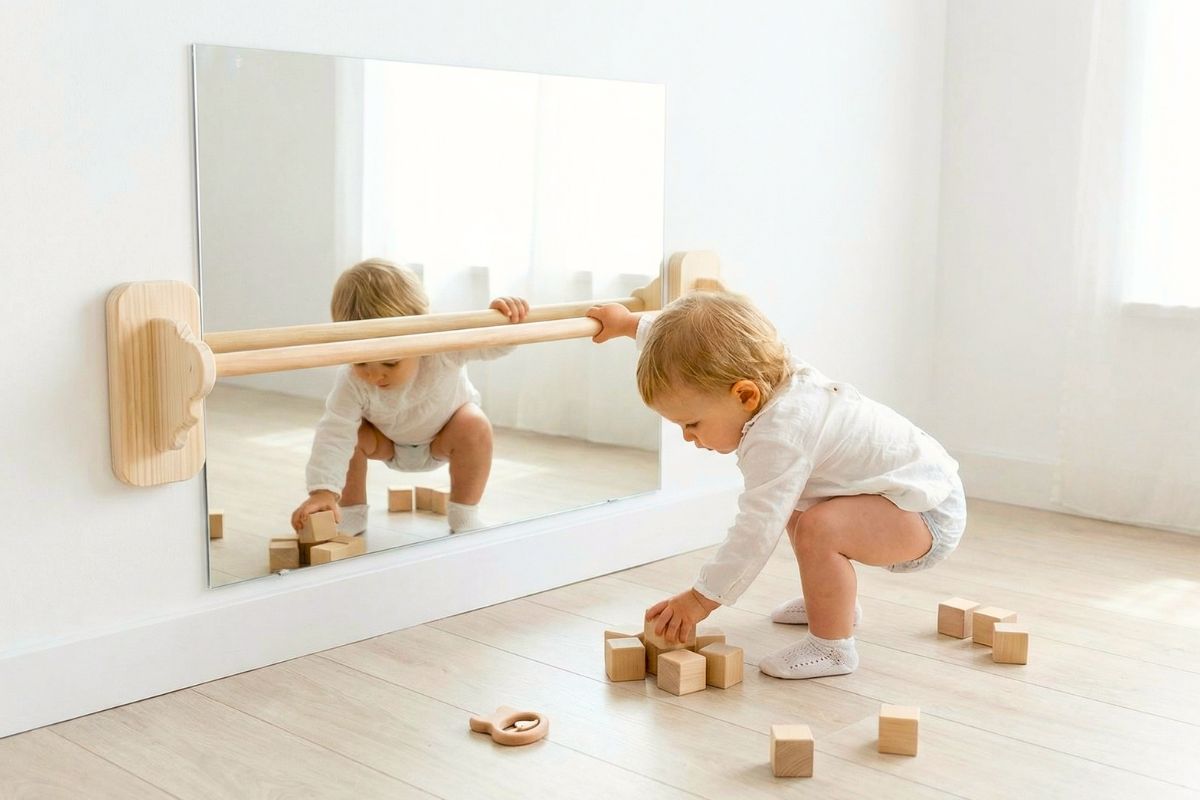
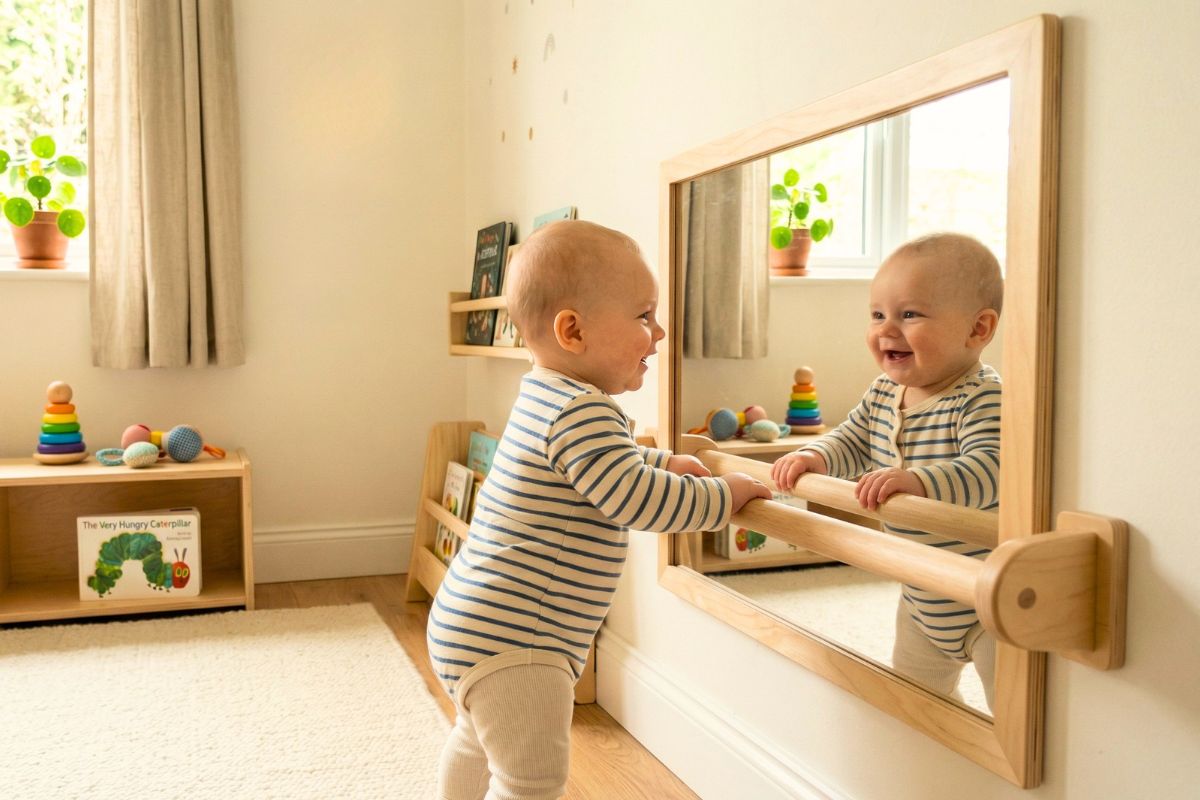
From around 7-8 months, when the baby begins pulling to stand, a horizontal bar at the right height beside the mirror gives them something sturdy to hold. This is one of the most-used elements in the second half of the first year. The bar should be solid, mounted at a height that allows the baby to grip it from a kneeling position and pull up. Paired with the mirror beside it, it becomes a space where the baby practices standing, cruising, and eventually letting go.
Month-by-Month: Development and Activities
The movement area is only as useful as the activities and materials within it. Here is what the developmental science says about each stage, and what to offer your baby in the movement area to support it.
Newborn (0-4 weeks)
Gross Motor
Arms and legs bent and usually symmetrical. Moro reflex (startle), fencing reflex, walking reflex present.
Fine Motor
Grasping reflex present. Hand is usually fisted.
The newborn is not passive. The reflexes present at birth (Moro, fencing, walking) are the body’s first motor programs, and they are working constantly. The baby is already mapping their body, feeling the difference between their own touch and the outside world.
In the movement area, lay the baby on their back on the topponcino or mat. Place the Munari mobile 25-30 cm above their eyes. The high-contrast black-and-white shapes match exactly what a newborn’s visual system can detect. Minimal stimulation, calm environment, close adult presence.
Offer in the movement area
Topponcino
Floor mirror (horizontal)
Black-and-white image cards
Month 2
Gross Motor
Gaining head control. Can turn neck left or right. Eyes start to follow dangling objects. Can tilt head back to look above. Holds head up during tummy time.
Fine Motor
Hand starts to open loosely. Grasping reflex still present. Can bring hands to midline. Reaching still largely ineffective.
The baby begins to follow the mobile with their eyes and occasionally bats at it accidentally. The mirror becomes more interesting: they are beginning to connect what they see in it with their own body. Tummy time becomes more productive as head control develops. Keep sessions short and positive: a few minutes at a time, frequently throughout the day.
Offer in the movement area
Floor mirror
Tummy time on firm mat
Month 3
Gross Motor
Holds head and upper chest up during tummy time. Can hold head up when tilted on back.
Fine Motor
Hand starts to open loosely. Grasping reflex begins to disappear. Brings hands to midline. Begins to observe own hands.
This is the beginning of intentional hand watching, one of the most important early cognitive events. The baby is starting to understand that they have hands, that they can control them, and that they can use them. A simple rattle placed near the hand encourages grasping exploration. The Gobbi mobile becomes relevant as color gradation perception develops.
Offer in the movement area
Simple wooden rattle
Interlocking rings
Floor mirror for tummy time
Movement Activities (0 to 3 Months): Munari mobile, Octahedron mobile, Gobbi mobile, simple rattle, interlocking rings, mirror.
Month 4
Gross Motor
Holds head and upper chest up during tummy time. Rolls from back to tummy. Begins to slither slowly.
Fine Motor
Efficient reaching begins. Palmar (whole hand squeeze) grasp with no thumb participation.
Rolling from back to tummy is a significant milestone and a sign the movement area needs more space. The baby can now move unintentionally out of their mat boundary. Expand the safe zone. Reaching becomes intentional: this is the moment to introduce the Dancers mobile (complex movement tracking) and the first tactile mobiles: a ring on a ribbon or a bell on a ribbon that the baby can bat and feel.
Offer in the movement area
Ring on ribbon / bell on ribbon (tactile)
Interlocking rings for grasping
Expanded floor space
Month 5
Gross Motor
Rolls from tummy to back. Slithers slowly. Stepping reflex (when held upright) disappears.
Fine Motor
Efficient reaching. Raking grasp using fingers only (no thumb yet).
Rolling is now fully established in both directions. The baby is beginning to slither toward objects of interest, which is exactly why the low shelf and interesting materials placed slightly out of reach work so well at this stage. Don’t move objects closer to make things easier. The reaching, stretching, and slithering toward something interesting is the work.
Offer in the movement area
Patchwork ball (varied textures)
Low shelf (2-3 items)
Object placed just out of reach to motivate slithering
Month 6
Gross Motor
Uses hands to slither faster. Begins to bear weight on feet. Can sit with support.
Fine Motor
Efficient reaching. Precise pincer with no thumb participation yet. Eyes and hands begin working together.
Hand-eye coordination is genuinely beginning. The baby can now reach for something they see accurately, not randomly. This opens up much more interesting interactions with objects. Simple wooden balls, small books, and the first pop-up toys become relevant. The floor space should be fully clear of obstacles. Don’t prop the baby to sit: let them get there on their own terms, which usually begins with sitting supported during this month.
Offer in the movement area
Pop-up toy
Wooden board book
Open floor space to slither freely
Movement Activities (3 to 6 Months): Ring on ribbon, bell on ribbon, ball with protrusions, patchwork ball, balls, pop-up toy, wooden book.
Month 7
Gross Motor
Begins to crawl. Pulls up to stand while holding on. Begins to bend knees (early squatting).
Fine Motor
Whole-hand grasp. Can transfer objects from hand to hand. Can wave.
Crawling changes everything about the movement area. The space needs to be substantially larger now and fully baby-proofed because the baby will reach every corner. Add the pull-up bar to the wall at the right height: this month marks the beginning of pulling to stand, one of the most practiced and satisfying actions in the second half of the first year. A glitter drum (observe the effect), and the first simple object permanence box work well here.
Offer in the movement area
Glitter drum
Object permanence box
Basket of balls
Fully expanded floor space
Month 8
Gross Motor
Cruising along furniture. Stepping reflex disappears. Begins to bear weight on feet more confidently.
Fine Motor
Monkey grasp: thumb plus next two fingers (not yet opposite fingers).
Cruising means the baby moves laterally along furniture or a wall while holding on. The pull-up bar and mirror become especially well-used: they will cruise along the bar, look at themselves, let go briefly, grab again. The knobbed puzzle and the object permanence box with drawer now make sense: the finger grip is developing precisely to handle them.
Offer in the movement area
Wooden egg and cup
Drawers (open/close exploration)
Pull-up bar for cruising
Movement Activities (6 to 9 Months): Glitter drum, object permanence box, wooden egg and cup, basket of balls, knobbed puzzle, drawers.
Month 9
Gross Motor
Standing against a shelf. Stepping reflex is gone. Bears weight on feet with more stability.
Fine Motor
Inferior pincer: grasps with thumb and index finger. Points with index finger. Begins voluntary release.
The infant pincer grip and pointing are genuinely exciting milestones. Pointing is among the first social communication acts: the baby is now directing your attention. The object permanence box with a drawer exercises the emerging ability to release intentionally. The push-balls-with-hands and Imbucare peg box become appropriate now.
Offer in the movement area
Object permanence box with drawer
Imbucare peg box
Low shelf at standing height for support
Months 10, 11 and 12
Gross Motor
Month 10: Pulls up to stand (possibly without support). Month 11: Takes uneven first steps. Month 12: Walking.
Fine Motor
Month 10-11: Precise pincer (tip of thumb + index finger). Throwing begins. Month 12: Smooth release for large objects.
These three months are when the movement area reaches its full expression. Walking, throwing, and stacking all begin. The walker wagon is a perfect first walking aid: pushed by the baby, at their speed, with complete control over stopping. A simple stacker and cubes on a dowel support the precise pincer that is consolidating throughout. Mirror repositioned vertically at standing height beside the pull-up bar if it hasn’t been already.
Offer in the movement area
Stacker
Cubes on dowel
Mirror at standing height
Wide open floor space for walking
Movement Activities (9 to 12 Months): Push balls with hands, object permanence box with drawer, Imbucare peg box, walker wagon, stacker, cubes on dowel.
The Complete Activity Overview (Birth to 12 Months)
Here is the full sequence in one place.
The 10 Guiding Principles for the Movement Area
These principles apply throughout the entire first year. They are worth re-reading as each new developmental stage begins.
- Prepare the movement area where the baby can spend time. Make it a yes space.
- Enlarge the space when the baby starts to slither, creep, and crawl.
- Provide opportunity and freedom to move.
- Remove obstacles to movement, like swaddles or props.
- Do not put the baby in containers (limit time in car seats, bouncers, playpens).
- Dress the baby appropriately to allow for comfortable movement.
- Observe the baby and provide activities that support their current stage of development.
- Do not interrupt or interfere with the baby’s activity while they are concentrated.
- Do not hurry or encourage any movement before the baby comes to it on their own.
- Allow the baby time. The schedule of development belongs to the child, not to us.
What to Observe in the Movement Area
One of the most underrated skills in Montessori parenting is observation. Before changing an activity, before adding something new, before moving on: watch.
Signs The Current Activity Is Right
- Focused, sustained attention (not necessarily for long, even 2 minutes is meaningful for a young baby)
- Repeated return to the same material across multiple sessions
- Calm body, engaged eyes
- Signs of effort: reaching, trying, adjusting grip, trying again
Signs To Rotate The Material
- Glances at it and moves on without engaging
- Has clearly mastered the action it requires and repeats it without effort
- Consistent disinterest over multiple sessions
Signs The Activity Is Too Advanced
- Frustration followed by complete withdrawal (not the effort-frustration-try-again cycle, but abandonment)
- Not yet able to physically access what the activity requires
Parents Ask Most Often
These questions come up every time this topic is discussed with parents who are new to the movement area.
Can I use a bouncer or swing occasionally?+
The Montessori position is to limit container time significantly rather than eliminate it entirely. A baby in a car seat is in a container but that’s unavoidable. A baby in a bouncer because you need five minutes to cook dinner is an understandable reality. The issue is not occasional use: it’s when containers become the default position for awake time, replacing floor time. Floor time is where all the development happens. Containers don’t offer the same opportunities for movement, and some (like the exersaucer) can actively work against natural motor development by asking the body to do things before it’s ready.
My baby hates tummy time. What do I do?+
Most babies who “hate” tummy time are being placed on their tummies for longer than they’re ready for, without enough visual interest to motivate them, or on a surface that’s too soft or too smooth to push against. Try: a firm surface (not a soft mat), a low mirror in front of them at eye level, very short sessions (30-60 seconds at first), and your own face at their level as the most compelling visual. The goal is for tummy time to feel like discovery rather than endurance. Two or three short positive sessions per day builds more than one frustrated longer session.
Should I encourage my baby to sit or stand before they do it on their own?+
No. This is one of the most important Montessori positions on movement. Propping a baby to sit before they can sit independently asks their spine and core muscles to bear weight before the strength supporting that weight has developed. The same is true for assisted standing. The Montessori principle is clear: “Do not hurry or encourage any movement before the baby comes to it on their own.” When a baby achieves a position independently, they have built exactly the strength needed to maintain it safely. When we put them there, they haven’t.
How many items should be on the shelf at a time?+
Three to five. This is not arbitrary: it reflects how babies process choice. Too many options means the baby’s attention jumps and they can’t settle into any single thing. Three or four items with adequate space between them, rotated every one to two weeks, is much more likely to result in sustained, focused engagement than a shelf overflowing with materials. When in doubt, put less out.
Does the movement area have to be a separate room?+
Not at all. Many families set up the movement area in the living room or the main family space, which is actually ideal in the early months: the baby can observe the family going about their day, which is its own form of stimulation. A defined rug, a low mirror, a mobile hook, and a small shelf is the complete setup: it can occupy a corner of any room. As the baby becomes more mobile, the space needs to grow, but even then, a baby-proofed section of the living room covers the need completely.
The Floor Is Where It All Begins
By the time my son was ten months old, the movement area had been rearranged half a dozen times. The mat had grown into most of the room. The mirror had moved from horizontal to vertical. The pull-up bar went up. The mobiles came down. Three different sets of objects had lived on the low shelf.
Each change happened because I watched him outgrow what was there, and set up what came next. The area didn’t follow a schedule: it followed him. That’s the whole point. The movement area is not a fixed setup you install once. It’s a living space that evolves alongside a child who is, in every single one of these months, doing the hardest and most important work of their life.
Start with a mat, a mirror, and a Munari mobile. Observe. Follow what you see. Everything else is just watching closely enough to know what comes next.
Scientific References
Carson, V., Zhang, Z., Predy, M., Pritchard, L. & Hesketh, K.D. (2022). Longitudinal associations between infant movement behaviours and development. International Journal of Behavioral Nutrition and Physical Activity, 19, 10.
Hewitt, L., Kerr, E., Stanley, R.M. & Okely, A.D. (2020). Tummy Time and Infant Health Outcomes: A Systematic Review. Pediatrics, 145(6), e20192168.